Verify Thom Browne Knit Top Storage, Weight & Shipping Costs
Daniel FosterEditor-in-ChiefPublished 22 October 2026This isn't about whether consolidation is always cheaper—it's about determining which costs for a thom browne knit top have been confirmed and which could still change before shipping. Before consolidating, you should put the item price, service fees, payment fees, packaging adjustments, chargeable weight, shipping quotes, storage status, and possible additional charges into a single record before deciding to proceed with consolidation, adjust packag
This isn't about whether consolidation is always cheaper—it's about determining which costs for a thom browne knit top have been confirmed and which could still change before shipping. Before consolidating, you should put the item price, service fees, payment fees, packaging adjustments, chargeable weight, shipping quotes, storage status, and possible additional charges into a single record before deciding to proceed with consolidation, adjust packaging, or delay shipment. 📦
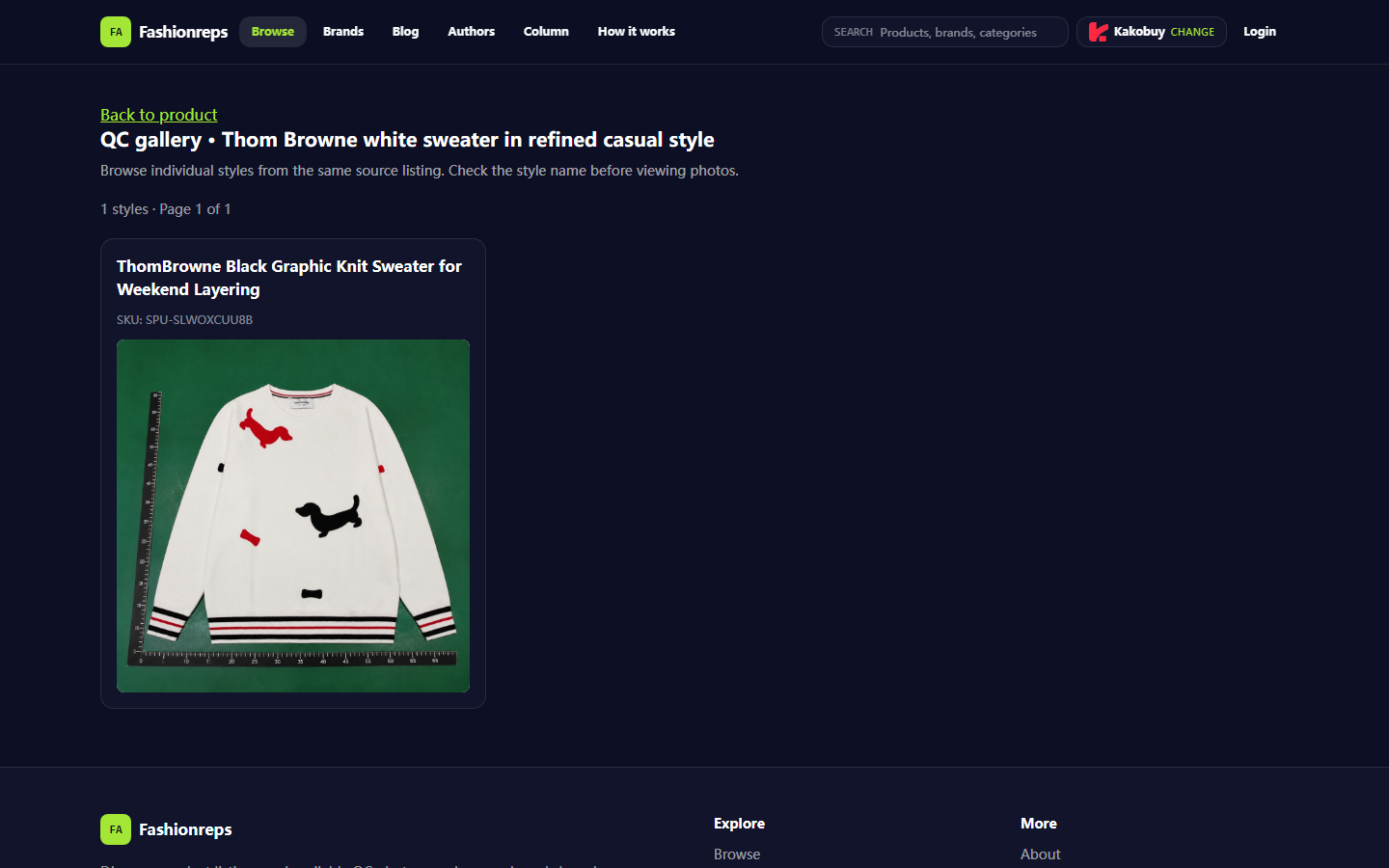
This article uses a thom browne knit top sample from the fashionreps page as the reference. The page shows a QC gallery and style name, but current evidence doesn't provide directly confirmable item price, storage deadline, actual weight, package dimensions, or destination shipping cost, so we won't write these as specific values. The image is only used to confirm the style identification scenario on the page and doesn't represent an actual purchase, receipt, or wearing experience.

Image: Product page screenshot used to confirm the correspondence between the style and the QC page.
Define the Specific Cost Decisions Before Consolidating the thom browne Knit Top
First, write down the decision to be made: keep the current packaging and ship directly, or request a packaging adjustment and then get a new quote; continue waiting to consolidate with other items, or ship this knit top now; accept the current shipping line quote, or switch to a line that meets the destination country's requirements.
Consolidation may reduce duplicate first weight or separate handling costs, but it may also increase total volume, volumetric weight, package declared value, or single-loss risk. Splitting shipments may incur more fixed costs but could lower the value concentration per package, or resolve line, size, and category restrictions. Without a package sample and line quote, you can't assume which option saves more.
After reading this article, users should be able to do three things:
- Find the item, storage, and QC records corresponding to this knit top.
- Enter the actual weight, dimensions, and fees before and after consolidation into the shipping calculator.
- Decide whether to proceed with consolidation, adjust packaging, or delay shipment based on verifiable results.
If the page only has blurry images, no corresponding order or storage records, or the destination country and delivery address are not yet determined, this article isn't suitable for making a shipping decision directly.
Confirm the Style, Color, Size, and Link Status from the fashionreps Page
The item discovery information on the fashionreps page cannot replace the order records from an external shopping agent. The page shows item discovery, source listing, or QC-related content; orders, payments, storage, and logistics are handled by the external agent you ultimately choose.
When checking, record item by item:
- The item name and style name shown on the page.
- The color, size, and whether they match the order record.
- Whether the item page still opens, or if it redirects, becomes invalid, or only shows tag content.
- Whether the QC gallery really corresponds to the current style, and not to other styles from the same source.
- Whether the item link, order number, and agent storage location correspond.
This sample page shows a QC gallery and style identification information, but based on that, we cannot confirm inventory, actual transaction price, current seller status, or the real feel of the knit fabric. Product images can help identify the style but cannot prove product quality, size accuracy, or final packaging condition.
Record Item Amount, Service Fees, Storage Status, and Package Quantity
Fee records should be separated by source, and don't treat the total shown on the agent's page as the logistics cost directly. It's recommended to keep the original currency, page time, and a screenshot or order voucher in the same record.
| Fee or Status | Evidence to Check | What Cannot Be Inferred Directly |
|---|---|---|
| Item amount | Order details or agent settlement page | Cannot infer price from QC images |
| Service fees and payment fees | Agent fee details | Cannot estimate by item amount ratio |
| Storage status | Storage location, inbound status, and operable period | Cannot infer free storage deadline from order date |
| Package quantity | Current list of packages to be consolidated | Cannot automatically treat different orders as one package |
| Packaging adjustment | Adjustment options and fees provided by the agent | Cannot assume removing shoe box, compressing, or changing box is free |
| Shipping quote | Official calculator or final settlement page | Cannot treat an old quote as current |
Item amount, service fees, and payment fees should be kept separate from shipping fees. This way, even if you change lines or re-weigh, you can tell where changes come from. If the system only shows a total amount, save the original page first, then confirm the fee breakdown with the agent to avoid duplicate payments or double-counting already charged fees.
Storage time especially needs to be checked for the starting point. Some systems may count from inbound, QC completion, package consolidation, or other events, so you can't infer it from the order date alone. If the page doesn't show a clear deadline, record the status as "to be confirmed" rather than "about to expire" or "still plenty of time". ⏱️
Check Actual Weight, Dimensions, and Volumetric Weight Input Before and After Consolidation
Logistics calculations usually rely on actual weight, package dimensions, destination, shipping line, and billing rules. Before consolidation, save the data for each individual package; after consolidation, save the new data; don't substitute clothing category or item name for weighing and measuring results.
At least record these fields:
- Actual weight and measurement time for each package before consolidation.
- Actual weight, length, width, height, and measurement time after consolidation.
- Whether the outer box was changed, original packaging removed, or protective materials added.
- Whether the calculator uses actual weight or volumetric weight.
- Billing weight rounding rules and minimum billing unit.
- Destination country, region, postal code, or address information required by the line.
A knit top may have different dimension results after packaging compression, box change, or added protection. Compressed packaging may also bring risks of wrinkles, deformation, or insufficient protection, so don't just look at volume reduction; also confirm whether the packaging plan is suitable for the garment and destination shipping conditions. 🧶
If only the weight changes before and after consolidation, without dimension or packaging records, the evidence chain is incomplete. In that case, you can request a re-measurement, but you should not fill in missing data yourself.
Use the Official Logistics Calculator to Verify Line, Chargeable Weight, and Current Quote
Shipping quotes must be based on the official calculator, settlement page, or traceable current quote from the selected agent or carrier. When querying, save the currency, destination, package weight, dimensions, line, query time, and restrictions at the same time.
Recommended order of operations:
- First query with pre-consolidation data, save the result and input conditions.
- Then query with actual post-consolidation measurement data.
- Confirm whether the calculator shows an estimated price, payable amount, or final pending review amount.
- Check if fuel surcharge, remote area, oversize, insurance, packaging, or other additional fees are included.
- Record the quote currency separately from the account settlement currency, and keep the exchange rate source or the converted result shown on the settlement page.
- Before payment, reconfirm that the line can still carry this item category and destination.
If you only know the item name but not the destination, weight, and dimensions, there isn't enough to calculate shipping. At that point, you can only state that more inputs are needed, not output specific savings or predict final logistics costs.
Exchange rates will also change the actual amount you pay. Record the original quote currency and the settlement currency used at payment, and don't mistake search page results, historical screenshots, or manual conversions for the current amount due.
Compare Storage Time, Packaging Adjustments, and Applicable Conditions for Possible Additional Fees
Storage time and packaging fees cannot be judged independently of package status. A package awaiting QC, a package that has passed QC, and a package already in the outbound process may have different operation options. Before consolidation, confirm whether each item has been received, whether there are pending issues, and whether packaging adjustment can still be requested.
Specifically confirm:
- From which event the storage period starts.
- After the deadline, whether it continues to charge, suspends operations, or requires manual handling.
- Whether consolidation will re-trigger weighing, packaging, or handling fees.
- Whether removing original packaging affects item protection, returns/exchanges, or shipping safety.
- Whether the line has restrictions on brands, replicas, liquids, batteries, or other categories.
- Whether the destination country may incur import taxes, customs clearance fees, or other receiver-side charges.
- What losses insurance covers, and whether additional declaration or keeping vouchers is required.
Customs and taxes should be handled according to the destination country's actual regulations and carrier requirements. Don't use under-declaration, splitting shipments to avoid taxes, or evading inspection to reduce the booked amount. Item declaration, recipient information, and payment records should not be filled with false information to save costs.
Stop Operations When Page Data Is Missing or Different Steps Cannot Be Matched
Pause consolidation or payment in the following situations:
- The fashionreps page style cannot be matched to the order record.
- The item link is dead, redirects abnormally, or only shows unrelated tag pages.
- QC images cannot be confirmed to belong to the current item or size.
- The storage package has no verifiable order number, location, or status.
- Post-consolidation weight or dimensions have no official measurement record.
- The logistics calculator lacks destination or key input fields.
- The quote currency, payment currency, and exchange rate source cannot be distinguished.
- Line restrictions, customs requirements, or additional fees have not been confirmed.
- The agent page shows only a total price, and fees cannot be broken down and no detailed record can be saved.
Stopping is not failure; it's avoiding repeated payments, repeated packaging requests, or selecting an unsuitable line when evidence is insufficient. Save the current draft, order record, and quote page first, then ask the corresponding agent for the missing fields.
After Completing Evidence Records, Decide Whether to Continue Consolidation, Adjust Packaging, or Delay Shipment
Use this decision logic to wrap up:
- If style, order, storage status, post-consolidation measurements, and current line quote all match, and destination requirements are confirmed, you can proceed with consolidation or payment.
- If weight or dimensions are high, but the cost, risk, and expected change of packaging adjustment are clearly evidenced, compare quotes before and after adjustment, then decide whether to adjust packaging.
- If consolidation only reduces duplicate fixed costs but significantly concentrates package value, increases volumetric weight, or raises single-loss risk, consider splitting.
- If the storage deadline is near but key data is missing, prioritize confirming storage and line rules, not skipping verification due to fear of expiration.
- If destination, measured data, or traceable quotes are missing, delay shipment.
The final record should clearly state four things: which set of measurement data is used, which line is used, in what currency fees are settled, and which fees may still increase during customs clearance, remote delivery, or manual review. Consolidation savings can only be calculated when the actual quote shows savings in duplicate handling or first weight costs; at the same time, note the increased volumetric weight, declaration value concentration, shipping damage, and customs risk.
Therefore, consolidation is suitable for those who already have multiple matching packages, are willing to save measurement and quote evidence, and can accept the change in single-package risk concentration. It's not recommended for those with unclear package status, unconfirmed destination or line restrictions, unresolved storage period disputes, or who cannot accept higher single-loss risk. After completing these checks, decide whether to continue consolidation, adjust packaging, or delay shipment.
About Daniel Foster
Kakobuy and Yupoo agent workflows, replica-apparel quality control, and cross-border shipping logistics.
Daniel Foster is Editor-in-Chief of Kakobuy Yupoo Review, overseeing all reviews and maintaining the testing standards. Coverage includes Kakobuy and Yupoo agent workflows, replica-apparel quality control and cross-border shipping, with both garment use and agent response included in reviews. Daniel wears every apparel item for at least three days before scoring and photographs all tags, stitching and hardware. Agent response times are recorded to the minute, allowing the article to describe both the physical checks and the waiting time within the service process.