Thom Browne Knitwear Buying Guide for Commuters
Daniel FosterEditor-in-ChiefPublished 14 October 2026If you're preparing to browse Thom Browne fall/winter knitwear on fashion-reps, the real problem to solve isn't deciding which piece "looks best" first. It's confirming whether the product page provides enough information for you to finalize sizing, plan commuter outfits, and ass
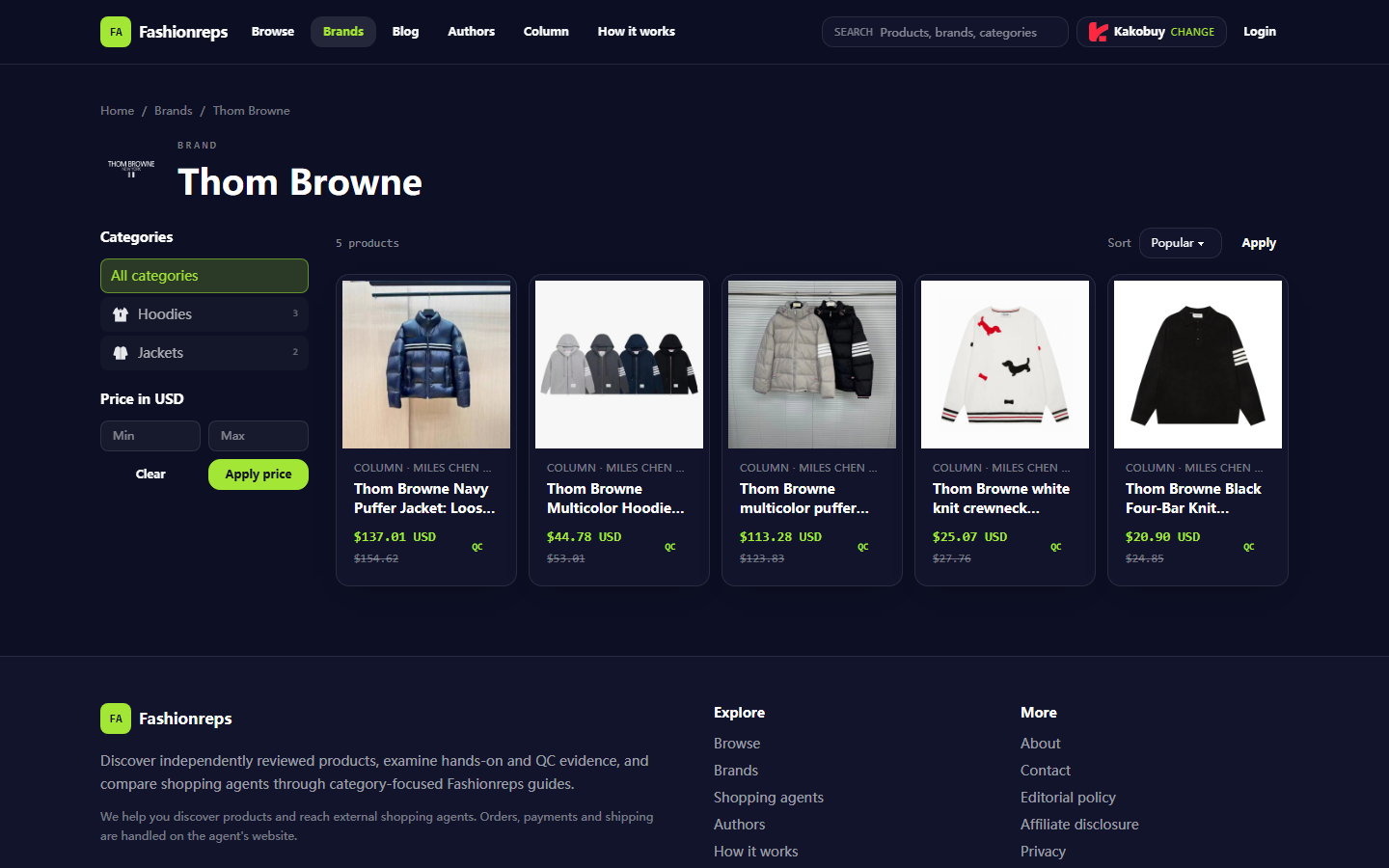

If you're preparing to browse Thom Browne fall/winter knitwear on fashion-reps, the real problem to solve isn't deciding which piece "looks best" first. It's confirming whether the product page provides enough information for you to finalize sizing, plan commuter outfits, and assess risks before ordering. This review covers the visible content on the catalog page, with a review date of October 14, 2026.
This page is suited for commuter buyers who have already settled on the Thom Browne style but haven't confirmed the fit and specifications yet. After reading, you should be able to do three things: narrow down knitwear pieces worth further investigation, list the size details you must confirm with the product page or a shopping agent, and judge whether the item will work with your everyday outerwear and trouser combinations.
First, a note on scope: the catalog page allows initial recording of colors, product names, some size ranges, and reference prices, but you cannot confirm actual material, weight, warmth, post-wash changes, or real fit from thumbnails alone. fashion-reps handles product discovery, content organization, and purchase links, while orders, payment, warehouse inspection, and shipping are managed by external shopping agents chosen by the user. 🧶
Defining the Commuter Buyer's Purchase Task and Evidence Scope
Commuter scenarios place more specific demands on knitwear than casual wear. The piece needs to layer well with shirts, tees, or lightweight base layers, and also adapt to office environments, commutes, and indoor air conditioning. Overly loose shoulder lines can make it hard to layer outerwear, a too-short length can reveal inner layers when sitting or reaching, and overly bold patterns can limit everyday styling options.
Therefore, this review limits the purchase task to: given limited visible information on the product page, determine whether a knitwear item is worth proceeding to the next round of size and QC verification, rather than declaring an item suitable for everyone.
Confirmable evidence includes:
- Items whose product names clearly include knit sweater, knit crewneck, or similar knit descriptions.
- Visible colors, patterns, reference prices, and size ranges on the catalog page.
- The page's brand category and current visible product count.
- Whether the product page has enough spec or QC entry points to continue verification.
Content that cannot be confirmed directly from the catalog page includes:
- Yarn composition, fabric density, and actual thickness.
- Flat measurements such as shoulder width, chest, length, and sleeve length.
- Drape, pilling risk, and washing stability after wear.
- Whether the item is still in stock, and the final price, service fees, and shipping costs from external agents.
Recording thom browne Knitwear Colors, Sizes, and Visible Details from the fashion-reps Product Page
The provided Thom Browne brand catalog page shows 5 visible products, with categories including Hoodies and Jackets. Within the catalog, two items directly relevant to knitwear screening can be identified: a white crewneck knit with a color-block dachshund motif, and a black four-bar knit listed as Mesh Knit with sizes M–2XL.
The catalog page also shows reference prices, but these should be treated only as page records, not as final or landed costs. External shopping agents may involve price changes, service fees, storage fees, international shipping, and destination taxes, so re-confirmation is necessary before ordering.
| Visible item | Currently recordable info | Still needs confirmation before purchase |
|---|---|---|
| White knit crewneck | White; crewneck; color-block dachshund motif; reference price $25.07 | Available sizes, flat measurements, material, motif placement, stock, and QC entry point |
| Black four-bar knit | Black; four-bar element; Mesh Knit; M–2XL; reference price $20.90 | Per-size measurements, mesh transparency, material ratio, stock, and QC entry point |
These two items are worth further verification, but you should not stretch the catalog page's text descriptions into conclusions about actual wear. For example, "Mesh Knit" may prompt buyers to focus on knit structure and breathability, but it doesn't automatically prove the garment is lightweight, cool, or suitable for winter wear alone; "crewneck" only indicates the neck style, not the collar's tightness, circumference, or layering space. 🔎
Checking Neckline, Length, Shoulder Line, and Fit Descriptions
A common oversight among commuter buyers is the interplay between fit elements. Neckline, shoulder line, and length are not three unrelated parameters; together they determine whether a knit can become a stable part of your daily wardrobe.
Start with the neckline. Crewneck knits are generally easier to pair with shirts and basic tees, but if the neck opening is too tight, the shirt collar may get crushed; if too loose, the inner layer edges can look messy. When the product page lacks neck circumference or flat measurements, list it as a to-be-confirmed item rather than inferring from image proportions.
Next, length. In commuter settings, the length should at least cover the waistband and keep inner layers from showing when sitting. With high-waisted trousers or straight-leg pants, a shorter knit may look crisp; with low-rise pants or when layering outerwear, a too-short length reduces styling flexibility. When the catalog page lacks length data, buyers should request a size chart or flat measurements instead of choosing solely by height.
The shoulder line determines outerwear compatibility. Natural shoulder lines usually fit more easily under suits, short jackets, or overcoats; dropped or wide shoulder constructions may create a roomier look but can also cause bunching at the outer sleeve. For items without explicit fit labeling, don't treat model photos or thumbnails as standard size evidence.
It's advisable to record the following questions item by item:
- Does the neckline have specific flat measurements?
- Are chest and length provided simultaneously for M, L, XL, etc.?
- Is the shoulder measurement taken from a natural shoulder line or a dropped shoulder?
- Is sleeve length measured from shoulder point to cuff, or from neckline to cuff?
- Does the size chart represent body measurements or garment measurements?
- Do different colors or patterns share the same fit?
Judging Layering Space for Commuter Outfits Based on Visible Page Information
When product page information is insufficient, styling judgments should follow a "color and structure first, material and warmth later" order. That is, first confirm whether the item can enter your existing wardrobe, then decide if it meets fall/winter temperature needs.
The white crewneck knit has a prominent color-block dachshund motif, with visual focus on the chest or torso area. It pairs better with low-contrast, minimal trousers and footwear, such as dark gray, black, navy, or medium-wash straight-leg pants. If you also pair it with a patterned shirt, eye-catching belt, or strong brand elements, the overall look may become too busy for a stable commuter environment.
The black four-bar knit is easier to slot into a commuter wardrobe due to its color, but the four-bar element itself is highly recognizable. When styling, reduce other high-contrast accessories and keep trousers simple. If the page's "Mesh Knit" indicates an open knit structure, consider it a potential mid-layer that may need a base layer, rather than assuming it's a thick winter sweater.
Layering space can be judged in three tiers:
- Worn alone: confirm whether the knit is see-through, whether the neckline lies flat, and whether the pattern or stripes suit an office environment.
- Layered over a shirt: focus on neckline size, chest allowance, and length to avoid bunching at the shoulders or hem.
- Layered under outerwear: focus on shoulder width, armhole, and sleeve length to prevent restricted movement once a suit or overcoat is on.
These judgments only describe styling limits; they don't confirm actual wear results. When the page lacks real measurements, try-on records, or clear detail photos, buyers should phrase conclusions as "worth further verification" rather than "worth buying." 👔
Practical Filtering Order for Trousers, Footwear, and Outer Layers
For commuter styling, you don't need to decide everything at once. A safer approach is to fix the trousers first, then choose footwear and outer layers based on the knitwear's visual focus.
Step one: define the trouser silhouette. The white patterned piece works better with dark straight-leg, tapered, or clean wool-blend dress pants to tone down the visual pop from the motif. The black four-bar piece offers more flexibility, pairing well with gray, navy, or black trousers, but avoid textures that are too strong, or the stripes and textures will compete.
Step two: choose footwear. Low-key leather shoes, Derbies, loafers, or clean low-top sneakers usually help maintain commuter proportions. Shoe color can be close to the trouser color to elongate the lower body; if the knit already has a bold pattern, avoid creating a second focal point with high-saturation shoes.
Step three: outerwear. Short jackets suit knits with a clean length; suits or overcoats require reserving shoulder and sleeve space. If the product page can't provide shoulder width, sleeve length, or thickness info, outerwear pairing can only be a style suggestion, not a fit conclusion.
Before ordering, use a simple rule: the more patterned the top, the more stable the trousers and shoes should be; the more basic the top's color, the more you need to check if the fit is too loose, too short, or too thin. This helps avoid buying items that "look attractive in the product photo but are hard to use in your actual wardrobe."
Distinguishing Product Specs, Image Observations, and Unconfirmable Material and Warmth Performance
To avoid treating speculation as fact, separate information into three layers.
Layer one: product specs. This includes colors, names, size ranges, reference prices, and knit descriptions explicitly stated on the page. This info can be recorded but still needs to consider page update times and changes on the external agent side.
Layer two: image observations. Images help judge motif placement, color contrast, neckline silhouette, and stripe distribution, but images are affected by lighting, compression, display settings, and shooting angles. Image observations cannot replace material labels, flat measurements, or QC details.
Layer three: currently unconfirmable performance. This includes warmth, softness, elasticity recovery, pilling speed, shrinkage, itchiness, and post-wash stability. If the page has no relevant description or evidence, mark these as unknown.
Regarding material, especially avoid inferring specific fiber content just because the product name includes knit, wool, or similar words. Buyers should prioritize finding material label photos, composition descriptions in product details, and labels visible during QC. Even if you see a label, confirm the photo belongs to the current color and size, not another variant.
Product Variants, Size Records, and QC Entry Verification Checklist
Before proceeding to an external shopping agent, create a brief record for each target item. The purpose is not to add steps but to avoid confusion when forwarding color, size, and links later.
Verify in the following order:
- Record the full product name, color, and size range shown on the page.
- Confirm the target color matches the main image, variant options, and detail images.
- Compare with flat measurements of your own clothes, not just body measurements.
- Focus on comparing chest, length, shoulder width, and sleeve length.
- Confirm the measuring method and tolerance range of the size chart.
- Check whether QC photo services are available for request or purchase.
- Confirm that QC photos clearly show neckline, cuffs, hem, motif placement, and labels.
- During warehouse inspection, check color, size, visible stains, damage, and stitching issues.
- Save the product page, variant selections, and QC results to avoid missing records for after-sales claims.
QC photos help identify visible issues; they do not prove material, comfort, or long-term durability. If key areas are not clearly visible in the photos, record it as insufficient information and contact the shopping agent to confirm if additional photos can be taken, rather than treating it as "no problem." 📦
Pause Conditions and Next Steps When Information Is Insufficient
Consider pausing the purchase if any of the following apply:
- The target color or size has no clear variant options.
- The product name doesn't match the style in the images.
- The page only shows a reference price, with no verifiable product details or size chart.
- Price, stock, or link status cannot be reconfirmed on the external shopping agent side.
- You need to rely on specific material, warmth, or fit promises, but the page has no corresponding evidence.
- The judgment that the item suits formal commuter wear is based solely on model photos or thumbnails.
If only size data is missing, first measure a well-fitting knit from your own wardrobe (chest, length, shoulder width, sleeve length), then seek corresponding info from the agent or product page. If material and label info are missing, prioritize requesting detail images or QC evidence. If the product link is dead, the safest approach is to stop using old records and not substitute items based on similar titles.
This catalog review helps buyers narrow down options, but it cannot replace product details, size charts, external agent checkout pages, and warehouse QC. For the white patterned piece, main risks are styling limits and motif details; for the black four-bar Mesh Knit piece, main risks are knit structure, transparency, and actual layering space. Neither should be ordered directly in your usual size without flat measurements.
Final recommendation: first compare flat measurements with existing clothes, then confirm the target variant, price, and QC entry point, and finally decide based on your commuter environment. If you cannot accept insufficient evidence on material, warmth, or after-sales support, it's not advisable to take on an incomplete-information purchase risk just for a familiar brand element.
Article Images
About Daniel Foster
Kakobuy and Yupoo agent workflows, replica-apparel quality control, and cross-border shipping logistics.
Daniel Foster is Editor-in-Chief of Kakobuy Yupoo Review, overseeing all reviews and maintaining the testing standards. Coverage includes Kakobuy and Yupoo agent workflows, replica-apparel quality control and cross-border shipping, with both garment use and agent response included in reviews. Daniel wears every apparel item for at least three days before scoring and photographs all tags, stitching and hardware. Agent response times are recorded to the minute, allowing the article to describe both the physical checks and the waiting time within the service process.