rick owens Boots QC: Verify Sole, Zip, Size Tag
Daniel FosterEditor-in-ChiefPublished 1 November 2026First, confirm what product this QC photo set corresponds to This QC record corresponds to the Rick Owens black high-top canvas shoes on the Fashionreps page, which is labeled as high-top shoes with cushioned soles and lists a black-and-white high-top style. The available evidence identifies it as a Ramones-style high-top shoe, not a boot that can be directly confirmed as a high-top boot. 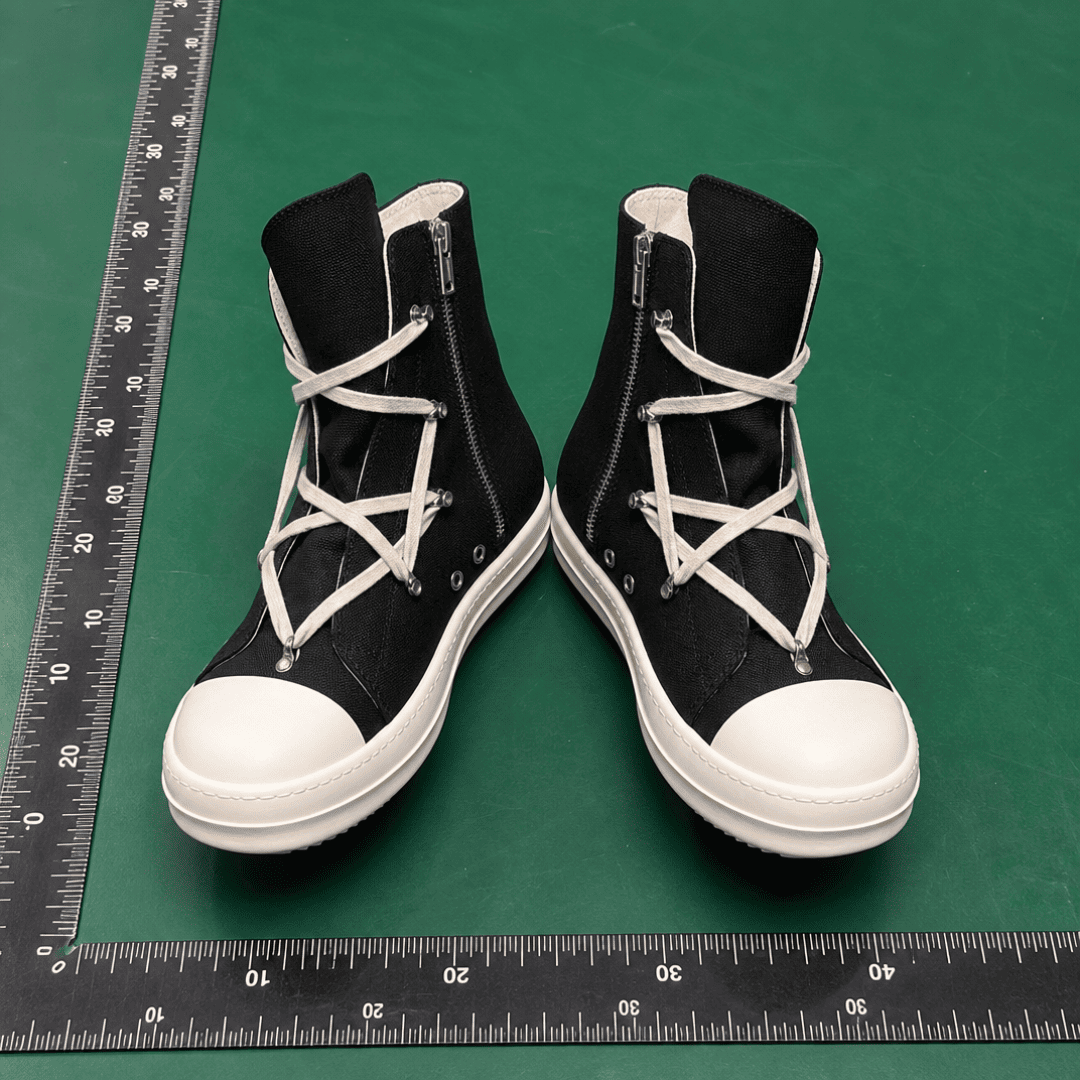
First, confirm what product this QC photo set corresponds to
This QC record corresponds to the Rick Owens black high-top canvas shoes on the Fashionreps page, which is labeled as high-top shoes with cushioned soles and lists a black-and-white high-top style. The available evidence identifies it as a Ramones-style high-top shoe, not a boot that can be directly confirmed as a high-top boot.

This is an important starting point: if you purchased a different pair of Rick Owens boots, you cannot treat this QC photo set as evidence for your target item just because the page uses the Rick Owens name. First, confirm the style, color, and size on the product details page, then access the corresponding photo gallery via the View QC Photos link on the page. If the shoe shape or color on the details page differs, you should pause your judgment.
What this QC evidence can currently confirm
The visible page evidence includes: the product is described as black high-top canvas shoes with a round toe and relatively flat sole; the QC page lists a black-and-white high-top style. The page also indicates that QC photo galleries are organized by source style, so you need to confirm the style name before viewing photos.
This information can support a preliminary check of the style correspondence, but it cannot independently prove the authenticity, durability, or final workmanship quality of the shoes. The current materials also lack photo-by-photo records needed to confirm the specific size tag, heel attachment, zipper end, and every stitch, so these parts cannot be written off as having passed QC.
The editorial judgment is: if your target item is indeed these black high-top canvas shoes, you can continue to view the corresponding gallery photo by photo; if your target item is a boot, especially a high-top, zippered, or significantly different heel structure style, you should treat this QC as mismatched evidence, not proof of qualification.
Check QC photos in order
1. First check the left and right shoes and overall style
The first step is not to look for flaws, but to confirm that both shoes belong to the same style. Check whether the toe shape, collar height, sole profile, lace hole arrangement, and color scheme are consistent. The left and right shoes should correspond structurally, and one should not look like a high-top shoe while the other shows a different shaft height or sole shape.
If the photos cannot clearly show both shoes at the same time, or the photos only show a single shoe without enough angles, you cannot confirm the paired condition from this. In this case, you should request additional photos showing both shoes together, side views, and sole photos.
2. Check the upper, creases, and stitching
Look at the toe, side, collar edge, and heel areas, and record any creases, indentations, stains, color differences, and loose threads actually visible in the photos. For canvas uppers, focus on whether the seams are continuous, whether the rubber edges show obvious glue overflow or breakage, and whether the splicing heights of the left and right shoes are roughly consistent.
Here you need to distinguish between two types of conclusions: visible facts such as loose threads or stains in the photos versus editorial judgment on whether they meet your acceptable workmanship standards. Do not conclude there are no flaws based on a single distant photo, nor write off minor creases as serious quality issues.
3. Check the sole and heel attachment
The sole needs to be examined from the front, side, and bottom tread patterns. Focus on recording whether the sole edges have openings, local lifting, obvious glue overflow, gaps, or discontinuous tread patterns. For the heel attachment, check whether there are unnatural gaps between the upper and the midsole or outsole.
The buyer feedback referenced on the product page mentions that sole separation and heel wear issues repeatedly come up in discussions about Rick Owens shoes. This can only serve as a pre-purchase risk warning, not proof that this particular pair already has the same issues. Only when you actually see the relevant parts in the corresponding QC photos can you record them as visible issues for this pair.
4. Check the zipper or other hardware
If the target shoe style has a side zipper, you should request photos that clearly show the full length of the zipper, the pull, the stop, and the connection between the zipper and the sole. The buyer discussion on the existing page specifically reminds you to check whether the side zipper ends in the correct position and does not extend directly to the sole edge.
However, the existing materials confirm a high-top canvas shoe page and do not provide a set of photo-by-photo evidence sufficient to confirm the zipper structure of a boot. Therefore, if your target is a zippered boot, the current QC cannot replace additional photos for that boot style. When the zipper is unclear, obscured by the upper, or lacks a complete side view, you should pause shipment.
5. Check the insole label and size correspondence
Size judgment must be based on mutual correspondence among the size selected on the product details page, the insole label in the QC photos, and the left/right shoe markings. If the size tag is illegible or the photos do not show the insole label, you can only confirm that the photos do not provide evidence; you cannot infer that the size is correct.
The buyer feedback compiled on this page is inconsistent on sizing: some think high-top shoes run large, while others choose true to size or a larger size due to wide feet. This discrepancy shows that you cannot blindly apply a fixed conclusion like "size down half" or "size up one." You should first check the seller's size chart, then compare your actual selection with the readable size tag in the QC photos.
When to request additional photos or pause shipment
If any of the following situations occur, it is recommended to request additional photos first and not treat the QC results as a basis for release:
- The product details page shows boots, but the QC page only corresponds to high-top shoes or another shoe type.
- The photos do not show both left and right shoes simultaneously, making it impossible to confirm same style and color.
- The sole tread, heel attachment, or outsole edge is obscured.
- The side zipper, buckles, or other hardware lack a complete side view.
- The insole size tag is illegible or cannot correspond to the order size.
- Key seams on the upper, heel, and sole edge are only shown in distant photos.
- Stains, glue separation, obvious color differences, broken threads, or structural deformation appear in the photos, but it cannot be determined whether they are merely caused by packaging.
Additional photo requests should be specific to the parts, such as "Please provide photos of both shoes together showing the front, outer side, inner side, heel, sole, and insole size label," rather than just asking for a new set of photos. This reduces repeated requests and facilitates item-by-item comparison.
Final shipment decision
If the target is the black high-top canvas shoes clearly corresponding to the page, and the QC photos can confirm the left and right shoes, sole edges, heel attachment, upper seams, and size tag, only then can you decide whether to proceed based on personal acceptability. The price, inventory, shipping, and service fees on the page should not be inferred from this QC material.
If the target is a Rick Owens boot, and the current evidence only confirms high-top canvas shoes, the conclusion should be to pause shipment and request QC photos for the corresponding boot style. Especially when the zipper position, heel attachment, and high-top structure lack clear evidence, you cannot write "no issues found" as the inspection result, nor use QC photos as a guarantee of authenticity or quality.
The most reliable use of this material is to confirm that the current photo gallery is associated with a page for black high-top canvas shoes; it is insufficient to replace a part-by-part check for the target boots.
About Daniel Foster
Kakobuy and Yupoo agent workflows, replica-apparel quality control, and cross-border shipping logistics.
Daniel Foster is Editor-in-Chief of Kakobuy Yupoo Review, overseeing all reviews and maintaining the testing standards. Coverage includes Kakobuy and Yupoo agent workflows, replica-apparel quality control and cross-border shipping, with both garment use and agent response included in reviews. Daniel wears every apparel item for at least three days before scoring and photographs all tags, stitching and hardware. Agent response times are recorded to the minute, allowing the article to describe both the physical checks and the waiting time within the service process.