Fear of God Essentials Hoodie QC: Drawstrings, Print, Size
Daniel FosterEditor-in-ChiefPublished 19 October 2026Clarify the QC Verification Task for fear of god essentials Hoodie The QC photos for the fall/winter hoodie are not about making the product look "authentic," but about determining whether the current photos are sufficient to continue verification. This article focuses on drawstrings, print, size label, color, stitching, hardware, pockets, and obvious flaws, establishing a repeatable viewing order to help you decide on fashion-reps whether to continue inqui
Clarify the QC Verification Task for fear of god essentials Hoodie
The QC photos for the fall/winter hoodie are not about making the product look "authentic," but about determining whether the current photos are sufficient to continue verification. This article focuses on drawstrings, print, size label, color, stitching, hardware, pockets, and obvious flaws, establishing a repeatable viewing order to help you decide on fashion-reps whether to continue inquiries, request additional photos, or hold off on purchasing.
Currently, the provided materials do not include valid hoodie product records that can confirm the corresponding style, nor do they show the product entering the target hoodie gallery through the View QC Photos button on the detail page. Therefore, the following will not write any hat images, product main images, or details of other styles as QC evidence for this hoodie. ⚠️
After reading, you should be able to accomplish three things: confirm whether the images correspond to the target product, distinguish between what is truly visible in the photos and personal judgment, and record items that need additional photos or confirmation from the seller. This article does not apply to authentication beyond a clear, complete, and corresponding QC photo gallery already confirmed to be for the same product, nor does it provide quality or authenticity guarantees.
Confirm Style, Color, and Size from the Target Product Detail Page
The first step must start from the target product detail page, not from search results, brand pages, category pages, or image file names. First, check whether the following information corresponds with each other:
- Whether the product name clearly includes Fear of God Essentials hoodie or an equally identifiable style name.
- Whether the product color is specified, such as gray, black, beige, or other specific color names; do not treat the visual color in photos as the official color name.
- Whether size options exist, and record the size selected at purchase.
- Whether the product fit, pocket style, chest or back print position matches the structure in the images.
- Whether the page has sufficient product information, rather than only tags, thumbnails, or blank descriptions.
Color judgment also needs to consider lighting, white balance, and background reflections. If one image is warmer and another cooler, you cannot judge color fading or inconsistency based solely on color temperature differences. Prioritize comparing the body, hood, and pocket areas under the same light source, and record "the photo shows a certain tone" separately from "the color name noted on the page."
Enter the Corresponding Product Gallery via View QC Photos
After confirming the detail page, use the entry clearly marked as View QC Photos on the page to enter the QC gallery. Do not manually piece together or guess the QC address, nor use images from another product as evidence for the target product.
After entering the gallery, first confirm the image context:
- Whether the page title, product name, or style information still points to the target hoodie.
- Whether the images show interrelated parts such as the body, hood, pockets, and labels.
- Whether the gallery includes multi-angle photos, rather than just one marketing main image.
- Whether the images are clear enough to distinguish print edges, stitching, and size labels.
- Whether there are duplicate images, failed-to-load images, overly cropped images, or images clearly belonging to other products.
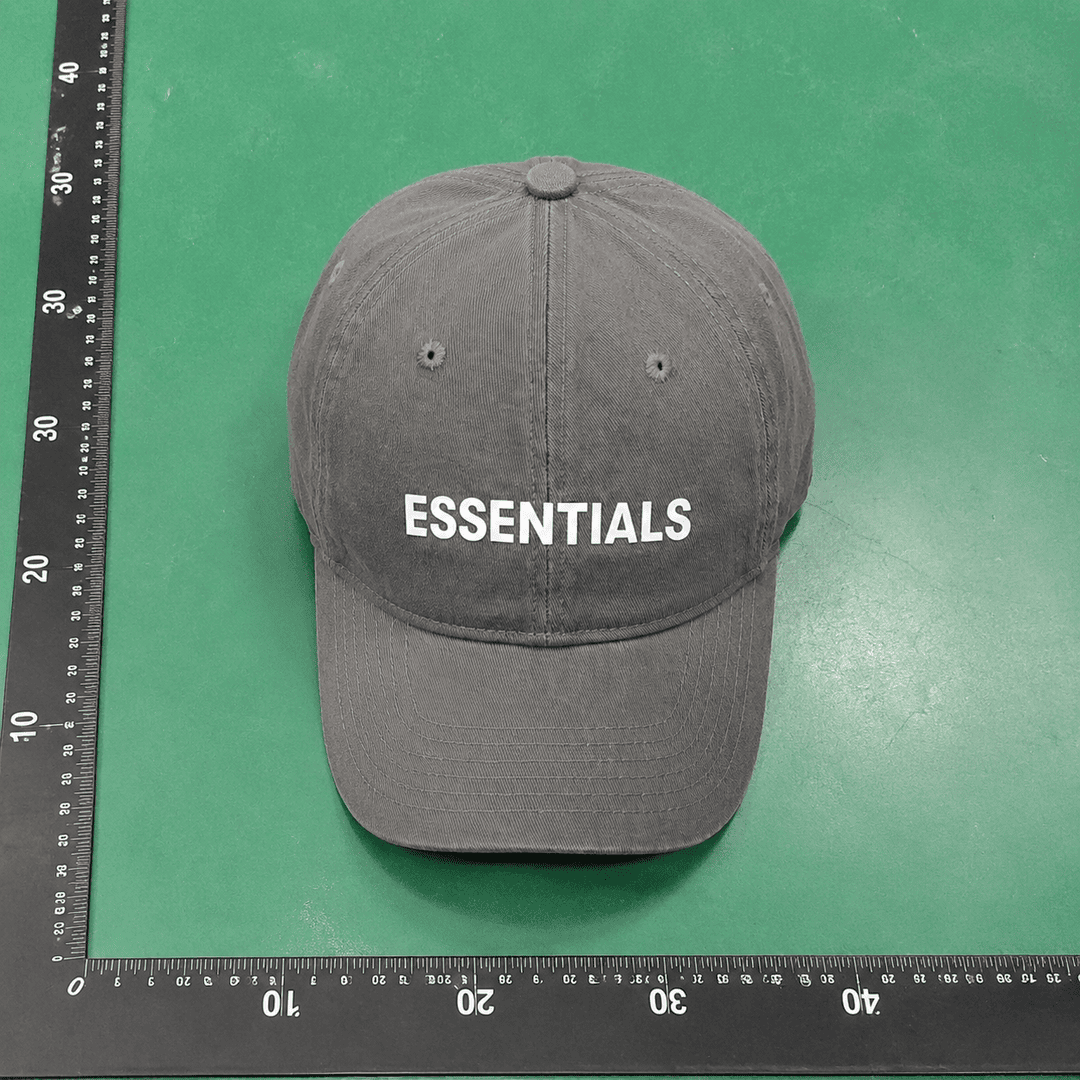
The image record provided in the current materials corresponds to a Fear of God Essentials gray baseball cap, not the target hoodie. This image can only be used as an example of "evidence mismatch," and cannot be used to judge the drawstrings, print, size label, or hoodie construction of the target product in this article. 🧭

Image correspondence note: The provided file record does not match the actual reference content, and cannot serve as original QC image evidence for this hoodie.
Check Visible Evidence of Print Position, Drawstrings, and Size Label
Print Position and Edges
First, check whether the print is on the chest, back, sleeves, or other positions, and then determine whether the images show the complete area. Record the following visible facts:
- The position of the print relative to the body centerline, top edge of pocket, or shoulder line.
- Whether any letters or patterns have partial missing, obvious breakage, glue bleeding, or unclear edges.
- Whether the print cannot be fully judged due to folding, shadows, or reflections.
- Whether left-right symmetry can be confirmed from a front flat-lay image.
"The position looks normal" is just an editorial judgment, not a conclusion of authenticity. If the photo angle is tilted, the body is not laid flat, or the print is blocked by the hood and wrinkles, it should be marked as unconfirmable, rather than given a positive assessment.
Drawstrings and Hood Opening
The drawstrings require at least seeing both ends, the eyelets, and the structure near the hood opening. Focus on:
- Whether the lengths of the two drawstrings can be compared from the same perspective.
- Whether the drawstring ends are intact, without obvious fraying, flattening, or abnormal fuzz.
- Whether there is loose thread around the drawstring openings, enlarged eyelets, or local wrinkles.
- Whether the connection between the hood opening and the body is obscured.
If there are only partial close-ups, you cannot judge whether the drawstring lengths are symmetrical; if there are no photos of the hood opening or eyelets, you cannot infer the internal structure from the front view of the body. 🧵
Size Label
The size label should be checked together with the size options on the product detail page and order records. The images need at least to clearly show the label position, size characters, and whether the label belongs to the same garment. Avoid the following mistakes:
- Guessing blurry letters as specific sizes.
- Treating packaging labels as internal size labels.
- Only looking at size characters, without noting whether the label is folded or obscured.
- Treating the existence of a label as proof of accurate size or proper fit.
A size label only proves that a visible marker exists in the photo; it cannot alone prove the actual size of the garment. If you are concerned about shoulder width, chest width, body length, or sleeve length, request additional flat-lay measurement photos and confirm the measurement method and units.
Check Whether Pockets, Stitching, and Overall Proportions Have Clear Photos
Pockets and Openings
The pocket area of a hoodie is easily obscured by wrinkles. When checking, observe whether the pocket opening is complete, whether there is obvious loose thread at both ends, whether the left and right heights are roughly consistent, and whether there is abnormal overlap between the pocket and the body print. If only a front long shot is available, you cannot judge the internal stitching and pocket edge details, and should list them as insufficient evidence.
Stitching and Seams
Check section by section along the shoulder line, armholes, side seams, hood attachment, and pocket edges. You can record:
- Whether there are obvious skipped stitches, broken threads, or loose threads.
- Whether seams have local bunching, skewing, or uncovered areas.
- Whether the image is clear enough to distinguish ordinary loose threads from structural seam opening.
One or two trimable loose threads are different from the risk of seam tearing, and should not be mixed as "poor workmanship." Similarly, shadows, garment folding, and compression noise in photos can create visual effects resembling flaws.
Overall Proportions and Color Consistency
Compare front, back, hood, and sleeve photos in the same record. Overall proportions can only serve as an appearance judgment, not a substitute for flat-lay measurements. Pay special attention to:
- Whether the front and back are indeed the same garment.
- Whether the proportion of the hood relative to the body is distorted due to folding.
- Whether color differences in different photos may be caused by lighting.
- Whether cuffs, hem, and shoulder lines are cropped.
If there are no back photos, label photos, or key seam close-ups, the conclusion should be written as "current images do not cover," not "no problem." 🔍
Distinguish Between Image Facts, Editorial Judgment, and Unconfirmable Items
It is recommended to divide QC records into three layers:
- Visible facts: e.g., "both drawstring ends are visible in the image," "the front print area is obscured by wrinkles," "the size label characters cannot be read."
- Editorial judgment: e.g., "the current angle is insufficient to determine whether the print is centered," "image clarity is insufficient to analyze stitches."
- Unconfirmable: e.g., "no back photo, cannot verify back print," "no flat-lay measurements, cannot determine actual body length."
Do not use conclusions that exceed the scope of image evidence, such as "authentic," "perfect," "guaranteed flawless," or "reliable quality." QC photos at most help you spot obvious problems or confirm some visible information; they cannot replace physical inspection, nor can they independently prove brand authenticity.
Conditions for Requesting Additional Photos, Inquiries, and Pausing When Evidence is Insufficient
If the target product detail page cannot be confirmed, or if View QC Photos does not open the corresponding hoodie gallery, you should first pause judgment and keep the current record. When consulting the seller or platform, you can make specific requests by item:
- Request a front flat-lay full image, ensuring the body edges are not cropped.
- Request a back full image, to check the back print and overall proportions.
- Request close-ups of both drawstring ends, eyelets, and hood opening connection.
- Request a clear close-up of the internal size label.
- Request detail images of pocket ends, shoulder line, armholes, and hem.
- If size needs to be determined, request flat-lay measurements of shoulder width, chest width, body length, and sleeve length, specifying centimeters or inches.
It is not advisable to continue ordering based solely on existing images in the following situations:
- The images clearly belong to another product or another color.
- Key parts are cropped, severely reflective, or out of focus.
- The product name, color, size, and images cannot correspond.
- The seller cannot provide additional photos or measurement information for the target product.
- Problems in the images may affect wearing or returns, but the current evidence cannot determine the extent.
Save QC Record and Decide to Continue Verification or Hold Off Purchase
When saving records, at least write down the product name, color, size, viewing date, image coverage, confirmed facts, pending evidence, and next actions. Do not mix non-corresponding images into the target product folder, and do not use screenshot file names as a substitute for product identity verification.
In the fashion-reps purchase process, QC photos only have practical decision-making value when the detail page, View QC Photos entry, image context, and key part evidence correspond to each other. The current materials show a reference image of a gray baseball cap, and valid QC evidence for the target hoodie is still insufficient. Therefore, a more prudent action is to complete the corresponding gallery and key close-ups before continuing verification.
About Daniel Foster
Kakobuy and Yupoo agent workflows, replica-apparel quality control, and cross-border shipping logistics.
Daniel Foster is Editor-in-Chief of Kakobuy Yupoo Review, overseeing all reviews and maintaining the testing standards. Coverage includes Kakobuy and Yupoo agent workflows, replica-apparel quality control and cross-border shipping, with both garment use and agent response included in reviews. Daniel wears every apparel item for at least three days before scoring and photographs all tags, stitching and hardware. Agent response times are recorded to the minute, allowing the article to describe both the physical checks and the waiting time within the service process.