Chrome Hearts Gray Tee QC: Leather Patch and Crystal Details
Daniel FosterEditor-in-ChiefPublished 24 October 2026This product page describes it as a gray short-sleeve T-shirt, with key visual elements including a cross leather patch, raised print, and crystal embellishments. Before ordering, when doing QC, the key is not to first judge "does it look authentic," but to check item by item whether the structures promised on the product page are clearly visible in the photos, and to record visible facts separately from editorial judgment. 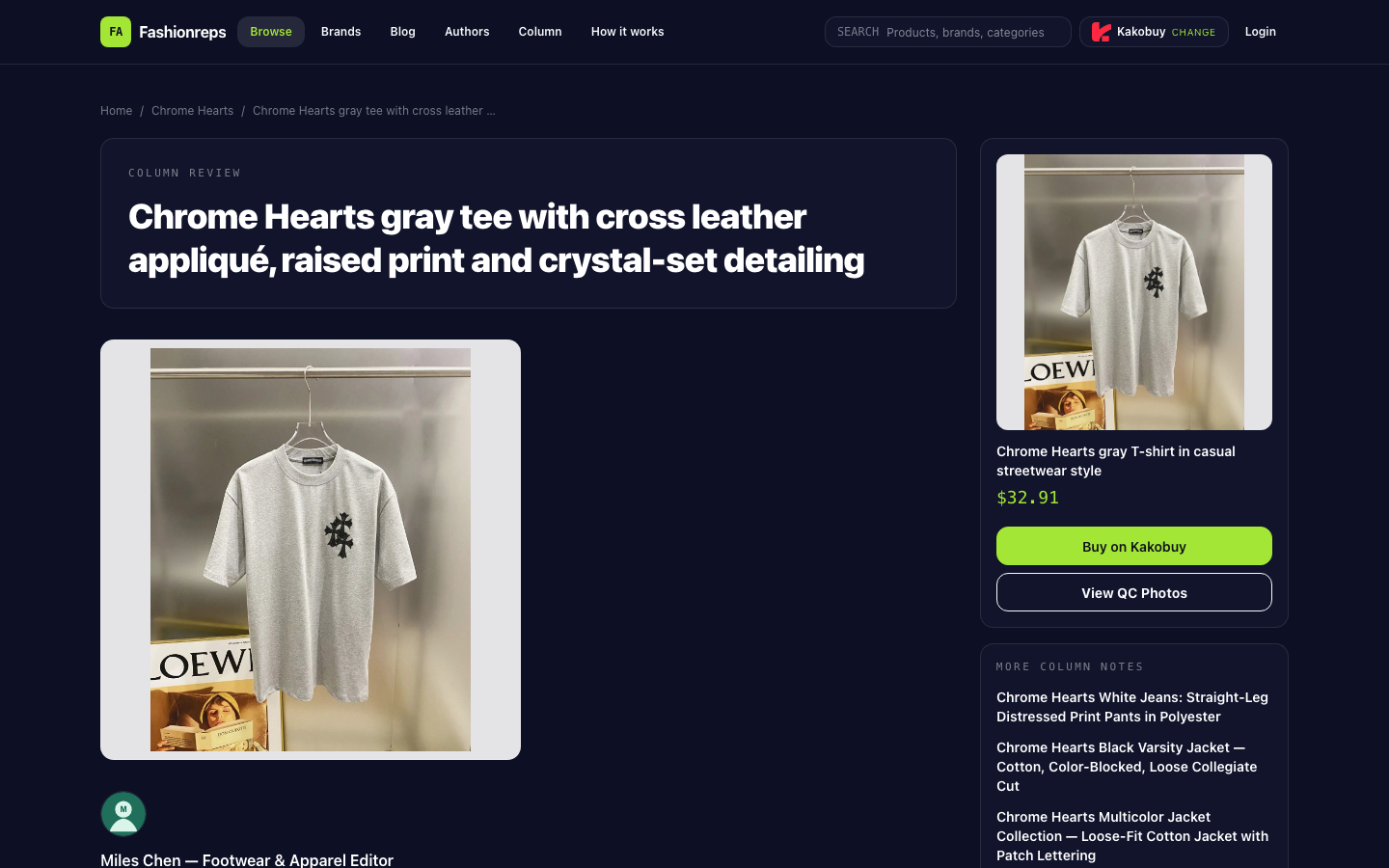
This product page describes it as a gray short-sleeve T-shirt, with key visual elements including a cross leather patch, raised print, and crystal embellishments. Before ordering, when doing QC, the key is not to first judge "does it look authentic," but to check item by item whether the structures promised on the product page are clearly visible in the photos, and to record visible facts separately from editorial judgment.

First, confirm whether the QC photos cover key areas
The product page shows an entry to view QC photos by style, but the source text provided does not list the content of each photo. Therefore, after receiving the QC photos, you should first confirm whether the following areas are clearly visible:
- The front cross pattern and its surrounding edges
- The connection between the leather patch and the body of the shirt
- The complete outline and surface condition of the raised print
- The arrangement area of the crystal embellishments
- The neck label, collar stitching, and main stitching
If the photos only show a distant view, or key decorations are obscured by folds, reflections, or shadows, you should not treat "not seeing any problems" as "confirmed no problems." It is safer to request additional photos before continuing the assessment.
First priority: Check the edges of the cross leather patch
The product page explicitly lists the cross leather patch as a major design structure. When inspecting, first check whether the patch fully covers the intended position, whether the edges are continuous, and whether there are obvious signs of lifting, misalignment, breakage, or irregular glue seepage.
Here we need to distinguish two types of information. Whether the patch is present and whether the edges have obvious abnormalities are visible facts that can be supported by QC photos; as for whether the leather material is completely consistent with a certain authentic version, it cannot be confirmed solely based on the product page text and limited photos. If the edges are obscured, it should be recorded as "cannot be determined" rather than directly judged as qualified.
Second priority: Check whether the raised print is intact
The source describes this item as having raised print, i.e., three-dimensional printing. Check whether the print outline is continuous, and whether there are obvious gaps, collapse, severe overflow, or unnatural overlap with the patch in the raised areas.
Print inspection should also pay attention to whether the surface has obvious cracks, peeling, or edge lifting. Relevant sources mention that buyers and authentication guides consider prints that are prone to cracking as a risk point to watch for, but these general discussions are not actual photo conclusions for this specific item. Therefore, when abnormalities are found, you can ask the seller to explain or provide additional photos, and you cannot make an authenticity conclusion based solely on one print detail.
Third priority: Check the arrangement and fixation of crystal embellishments
Crystal embellishments are another visible structure that distinguishes this gray T-shirt from ordinary printed versions. When inspecting, you can check by area:
- Whether crystals appear in the embellishment area described on the product page
- Whether there are obvious gaps, skewness, or abnormal density in the arrangement
- Whether there is any falling off, looseness, or exposed glue marks
- Whether reflections hinder judgment and whether requests for different angle photos should be made
Reflections in a single photo cannot directly prove the quality of the crystals, nor can they prove that every embellishment is firmly fixed. If a part is overexposed or the resolution is insufficient, that item should be marked as pending confirmation.
Fourth priority: Check the neck label and stitching, but do not overstep conclusions
The neck label, collar stitching, and main stitching are basic QC items. Observable information includes whether the text is clear, whether there are obvious spelling errors, whether the neck label is crooked, and whether the stitching has large sections of skipped stitches, broken threads, or obvious loose threads.
Authentication discussions in the source mention that a clear and correctly spelled neck label, accurate pattern embroidery, and print condition are often used as reference points. However, these are general authentication criteria, and a product QC photo cannot be directly upgraded to an authenticity certification. A more accurate statement for this item should be "visible inconsistency found" or "current photos insufficient to confirm," rather than "therefore definitely authentic" or "definitely fake."
Record results with a checklist
| Inspection Item | What can be confirmed in the photos | Situations that require pause and consultation |
|---|---|---|
| Leather patch | Cross structure, edges, and attachment status | Edges obscured, obvious lifting, or position inconsistent with product description |
| Raised print | Outline, raised effect, and surface integrity | Cracks, peeling, severe overflow, or unclear in photos |
| Crystal embellishments | Arrangement area, missing stones, and looseness signs | Excessive reflections, missing stones, skewness, or obvious glue marks |
| Neck label and stitching | Text clarity, stitching continuity | Spelling abnormalities, large skipped stitches, broken threads, or illegible |
Handling order when discrepancies are found
First step: Save the corresponding QC photo and mark the specific location, such as "lower edge of left cross patch" or "upper right area of crystal arrangement." Second step: Describe only the observed phenomenon, without directly using authenticity conclusions. Third step: Ask the seller whether it is the same item, and request close-up photos or videos from the corresponding angles. Fourth step: If key decorations still cannot be confirmed, or the seller cannot explain obvious inconsistencies, pause the purchase process.
The source information for this item is sufficient to confirm that the page description includes a gray short-sleeve, cross leather patch, raised print, and crystal details, but it is not enough to complete the authenticity certification of the actual item for the buyer. The practical value of QC is to first rule out missing decorations, structural misalignment, print damage, and stitching abnormalities, and then decide whether further consultation is needed.
About Daniel Foster
Kakobuy and Yupoo agent workflows, replica-apparel quality control, and cross-border shipping logistics.
Daniel Foster is Editor-in-Chief of Kakobuy Yupoo Review, overseeing all reviews and maintaining the testing standards. Coverage includes Kakobuy and Yupoo agent workflows, replica-apparel quality control and cross-border shipping, with both garment use and agent response included in reviews. Daniel wears every apparel item for at least three days before scoring and photographs all tags, stitching and hardware. Agent response times are recorded to the minute, allowing the article to describe both the physical checks and the waiting time within the service process.