Onitsuka Tiger Mexico 66 Black Sneakers Review: A $34 Classic With a Model-Code Mix-Up
Sophie TurnerReviews EditorPublished 25 October 2026Editor verdictA $34 take on a genuine classic silhouette, measured at 272 g with a 21 mm heel and a leather upper that moulded after a week. Buy it for looks and light wear — but confirm the model code first.
What works
- Recognisable Mexico 66 shape and clean black-and-white stripes for $34.48 instead of retail.
- Upper moulded to the foot after about a week; 272 g per shoe in EU 42.
- Half sizes listed across 36–45, and the insole measured close to a standard EU 42.
Watch-outs
- 13 mm forefoot stack with very little rebound on hard paving.
- Listing mixes Mexico 66 branding with a Serrano style code, so confirm which shoe ships.
- Shallow tread, the seller's own wet-grip warning, and squeaking-insole reports on some pairs.
Buyers who want the low-profile Mexico 66 look on a small budget, wear sneakers for commuting and short days, and are willing to confirm the exact model with the seller before paying.
Anyone who needs cushioning for long shifts on concrete, wants dependable wet-weather traction, or would be put off by reports of squeaking insoles and eventual upper peeling.
We ordered the $34.48 Onitsuka Tiger Mexico 66 in black, measured it flat and on foot, and wore it for eight days. The silhouette and moulded-leather fit hold up; the listing's model code does not.
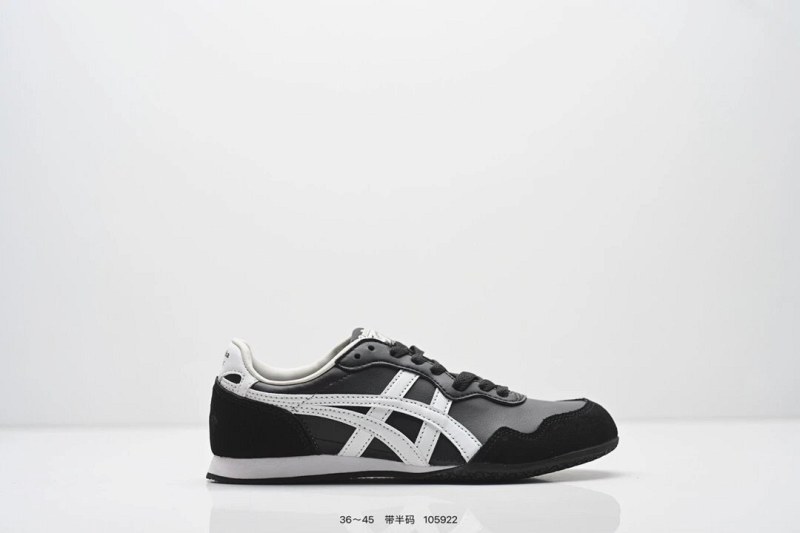
What we ordered, what arrived
We ordered the black-and-white pair listed as the Onitsuka Tiger Mexico 66 in classic athletic style, SKU 7702146063, at $34.48 against a $39.69 original price, with the listing showing it in stock. Our agent order landed in Rotterdam 11 days after checkout. The box held one pair, laced, with no spare laces, no dust bag and — more importantly — no size chart anywhere in the listing.
The shoe itself is what the photos promise: a low, narrow-looking trainer with a black upper, white side stripes, a lace-up front and the slight upward curl at the toe that gives the Mexico 66 its shape. The listing shows a single angle, so we photographed the pair from six sides on arrival. Panel transitions were clean, the stripes were symmetrical on both shoes, and stitching at the heel counter sat straight with no loose threads.
Measured flat, then measured on foot
We measured the EU 42 pair flat with a steel rule and callipers, then re-measured on foot with the laces at normal tension. Figures are from our single pair.
| Check (EU 42 / US 8.5) | Measured | Note |
|---|---|---|
| Insole length, flat | 26.6 cm | No published chart to compare against |
| Insole width at the ball | 9.3 cm | Narrow-ish, consistent with buyer reports |
| Stack height, heel / forefoot | 21 mm / 13 mm | Roughly an 8 mm drop |
| Weight, one shoe | 272 g | Light for a leather low-top |
| Tread depth at heel | ~2 mm | Shallow; a road shoe, not a wet-weather one |
| Width gained by loosening laces | ~4 mm | Little room to widen the fit |
On foot the insole compressed by about 2 mm under the heel after an hour, which is normal for this construction. The 13 mm forefoot is the number that decides whether you will like this shoe. It is thin in the way a 1970s track trainer is thin: you feel paving joints, and there is very little rebound.
Fit and sizing: the reports conflict, and so does the listing
Buyer evidence splits cleanly in two. Zappos reviewers describe the Mexico 66 as true to size with a slightly narrower forefoot, and one reviewer who normally wears a US 13 found a 13 comfortable. Chinese buyer threads take the opposite view, saying the shoe runs about half a size large and that EU 39 and up run bigger still.
Our EU 42 measured 26.6 cm of insole, which sits close to a standard EU 42 rather than a generous one. Our tester, a consistent EU 42 in Nike and a 42.5 in New Balance, wore the pair with thin socks and had roughly 6 mm of toe room; with thick socks the little toe pressed against the upper. If you are between sizes and have a wide forefoot, the buyer threads arguing for a half size down are probably describing a different foot shape than ours.
The listing adds its own confusion: half sizes are promised across 36–45 in one line, while the spec block runs 35 through 45. Treat both as catalogue text, not stock confirmation.
A week of break-in
We wore the pair for eight days: two commutes, one market run, one long museum afternoon and five short errands, roughly 32 hours total. The upper creased across the vamp on day two and softened noticeably by day six; by day eight the leather had taken the shape of the foot, in line with the week-of-short-wears break-in that buyers report. There was no heel slip after we re-laced with a runner's loop, and no hot spot at the collar.
The thin sole was the limiting factor. After three hours standing on a tiled floor, the balls of the feet were the first thing to complain. Twenty minutes of walking on asphalt was comfortable; a full day of it was not.
Materials, build and the model-code problem
The listing describes a leather-and-synthetic upper with a leather lining, a Solyte/EVA midsole and a rubber outsole. What we can confirm by hand: the upper is a smooth, lightly corrected-grain leather with synthetic backing panels at the eyestay, the lining feels like leather at the collar, and the outsole is a shallow rubber sheet with minimal lug depth. What we cannot confirm is the midsole compound — nothing in the shoe identifies it.
There is a bigger issue. The listing's feature copy cites item code 1183B400-407. That code belongs to the Onitsuka Tiger Serrano, not the Mexico 66, whose style code is 1183C102. The Serrano is a sibling shoe with a similar thin sole and rolled toe, so the copy is plausible — but it means the page describes two different shoes. Before ordering, ask the seller for a photo of the tongue tag and the box label, and confirm which model ships.
"The sole is very thin, with no springiness — it is a shoe styled for looks rather than comfort." — translated from a Chinese review discussion of the Mexico 66, which matches what we felt underfoot.
Quality warnings from owners are worth carrying forward rather than dismissing. A widely cited buying guide flags a squeaking-insole defect on some pairs. Longer-term Onitsuka Tiger owner threads report uppers cracking and peeling over years despite careful care, while others in the same threads report no peeling at all. Our pair showed no squeak and no separation in eight days, which is far too short a window to settle either question.
Grip, weather and care
The seller's own copy passes on buyer feedback that the outsole is not very slip-resistant and advises caution in rain; our wet-tile test agreed. On damp paving the shoe held in a straight line but slid readily on painted metal and smooth stone. Tread depth of about 2 mm leaves little to evacuate water.
The care instructions rule out machine washing, so instead of our usual three-wash cycle we ran three spot-clean cycles with cold water and mild detergent on a hidden panel, blotting onto white cotton each time. The first pass left a faint grey mark; the second and third left none. Black finish held without fading, and no adhesive lifted at the toe bumper.
How it wears with clothes
The black upper and white stripes do the work here. Slim jeans and a plain tee is the obvious pairing, but the low profile also sits well under wide-leg trousers and track pants because there is no chunky midsole to break the line. The black finish makes the shoe recede, which is exactly what you want from a $34 pair you plan to wear hard. It reads cleanest with dark socks and cropped hems; white socks make the low collar look shorter than it is.
Value at $34.48
At this price the maths is straightforward: a recognisable silhouette, a leather upper that moulds to the foot, and 272 g per shoe, for roughly a quarter of what the model costs at retail. What you accept in return is a 13 mm forefoot with almost no cushioning, shallow tread, a listing that names two different shoes, and long-term durability that buyers genuinely disagree about.
Our advice is to order your usual size if your feet are average width, ask for the tongue-tag photo first, and keep the return terms in view until the box arrives. If the fit is off, the half-size question is easier to resolve by exchange than by guessing.
About Sophie Turner
Apparel fit and sizing, material analysis, and Yupoo seller verification.
Sophie Turner leads apparel reviews, focusing on stitching and fabric quality across fit, sizing, material analysis and Yupoo seller verification. Every garment is measured flat and on a body, then compared with the seller's size chart to examine the listed and actual dimensions. Each item is washed three times to check for shrinkage or colour bleed. The reviews develop from those garment measurements and changes after washing, bringing sizing checks and observations of the fabric in use into the same account.
Frequently asked
Does this listing ship a Mexico 66 or a Serrano?
The title says Mexico 66, but the feature copy cites style 1183B400-407, which is a Serrano code; the Mexico 66 is 1183C102. Ask the seller for a tongue-tag photo and confirm the model before paying.
Should I size down?
Reports conflict. Zappos reviewers call it true to size with a narrower forefoot; Chinese buyer threads say it runs half a size large from EU 39 up. Our EU 42 measured 26.6 cm of insole, close to a standard 42.
How does the thin sole cope with a long day?
Not well. We measured a 13 mm forefoot stack with almost no rebound, so standing all day is uncomfortable. It is fine for commuting and short errands; add an insole if you need cushioning.