The White Arc'teryx Shell Is a Commitment, Not Just a $137 Bargain
Sophie TurnerReviews EditorPublished 22 October 2026Editor verdictA tidy white shell at a shopping-agent price that held its shape and beading through three washes. Confirm membrane, measurements and condition first: white hardshells yellow, and delamination reports are common enough to matter.
What works
- Size M measured 114 cm at the chest, enough for a thin mid-layer
- Seam tape and zips clean; beading recovered after every wash
- Listed across S–XXL, so most frames have an option
Watch-outs
- No seller size chart, and no membrane named beyond a zip tag
- Collar and cuffs grey quickly; owners report yellowing
- Owner threads report delamination after light use
Buyers who want a light-coloured layering shell for city and travel use, and who will message the seller for measurements and fabric details before paying.
Anyone who wants a low-maintenance shell that hides dirt, or who needs documented membrane and condition details before committing.
A $137.31 white hardshell with Arc'teryx branding and a GORE-TEX tag on the zip. Our measurements, three wash cycles and seam checks found a usable layering shell, but the light colourway and unconfirmed membrane spec are real risks.
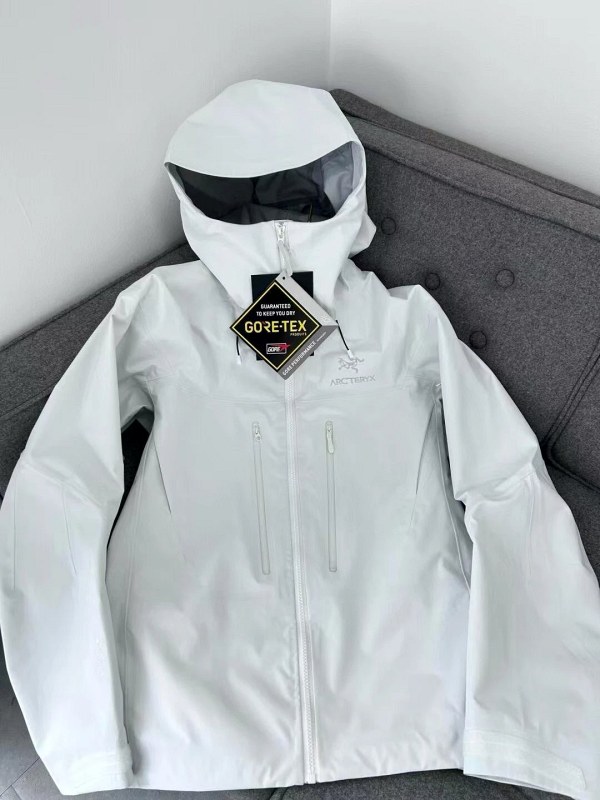
White outerwear is a styling decision first and a practical one second, and this Arc'teryx-branded hardshell is priced to make that decision easy: $137.31 through the agent, down from a listed $154.90, in sizes S–XXL. We ordered a size M in the polar white colourway, put it on two different frames, measured it flat and on-body, and washed it three times at 30°C to see whether the finish, the seam tape and the fit survived. Our score is 4.0 / 5 — a good shell with two caveats you should price in before you order.
What arrived, and how it measured
The parcel contained the jacket only: attached hood, full-length front zip, two vertical chest pockets, high collar and dark interior lining that shows at the hood opening. The listing gave S–XXL and nothing else — no seller size chart, no membrane name, no weight — so we compared our sample against Arc'teryx's published men's shell chart instead of a seller table.
| Measurement (size M) | Our sample | Reference |
|---|---|---|
| Chest, pit-to-pit flat | 57 cm (114 cm circumference) | Arc'teryx men's M body chest 96.5–101.5 cm |
| Back length, collar seam to hem | 74 cm | No listing figure |
| Front length | 71 cm | No listing figure |
| Shoulder, seam to seam | 47 cm | No listing figure |
| Sleeve, shoulder seam to cuff | 63 cm | No listing figure |
| Hem, flat | 55 cm | No listing figure |
Read against Arc'teryx's own chart, that 114 cm chest leaves roughly 13 cm of ease over a body measuring 101 cm at the top of the size band. That is a layering shell, not a fitted one: a thin fleece and a baselayer went underneath without the front zip pulling at the chest, and the sleeves cleared a mid-layer cuff without dragging it down.
Three washes: shrinkage, beading, colour
We washed the sample three times on a 30°C technical cycle with a non-biological detergent, no softener, and air-dried it flat each time. Changes were small and inside what we would accept:
- Back length went from 74.0 cm to 73.6 cm; sleeve from 63.0 cm to 62.7 cm; pit-to-pit from 57.0 cm to 56.8 cm. Nothing that changed how the hem sat over a mid-layer.
- Water beaded and rolled off the shoulders and hood after every cycle. Beading on the sleeves and the chest-pocket flaps faded by the third wash, which is normal for a factory-applied finish and not a sign the shell itself failed.
- No dye transfer from the dark lining into the white face fabric, including at the collar where the two meet.
The colour did not stay pristine. After three wears and three washes, the inner collar edge and the cuff hems had picked up a light grey cast that a spot clean improved but did not remove. That is three cycles, not three seasons — and it is the single clearest warning we can give about this colourway.
Construction checks
Seam tape sat flat along the shoulder seams, the armholes and the hood seam, with no lifting at the curve where tape usually fails first. The main zip ran cleanly through twenty open-and-close cycles and the chest-pocket zips sat flush under their flaps. The hood has a rear volume adjuster and a stiffened brim; with the collar fully zipped, the hood turned with the head rather than sliding. Hem drawcords and cuff tabs both held their setting under tension.
What we cannot verify from the garment is the membrane itself. The only branding on the shell is the GORE-TEX tag on the front zipper, and a zip tag is not a specification. The listing does not name the fabric, the membrane or the face weight, so the waterproof claim is supported by our observed beading and taped seams — not by documentation.
Fit, sizing and the between-sizes question
Arc'teryx's own guide is unusually specific and worth following here: the men's fit was recently revised, smaller sizes are now tighter and larger sizes looser, and if your measurements fall between sizes you take the larger for a looser fit and the smaller for a tighter one. Our size M behaved that way — roomy enough to layer, not boxy through the waist. Owners in public threads generally describe Arc'teryx shells as true to size and many size up to fit mid-layers; with 13 cm of ease at the chest, we would only size up if you plan on a down or grid-fleece mid-layer rather than a thin one.
Because the listing supplies no measurements, ask for pit-to-pit, back length and sleeve before you pay, then compare those numbers with the chart above rather than with a letter on a label.
The two risks we would not wave away
First, the colour. Owners of white and other bright Arc'teryx hardshells repeatedly flag visible yellowing and staining and say they are harder to keep clean than darker options. Our three washes cannot confirm or rule out long-term yellowing, but the collar and cuff grime we already have is consistent with those reports.
Second, durability. Some Arc'teryx hardshell owners report delamination of the shell after comparatively light use. That is a category-level report from owner threads, not a finding about this jacket, and our sample showed no bubbling or tape lift — but it is the reason we would keep the seller's condition photos and your order record.
Treat the white finish as a consumable, not a fixed feature: budget for spot cleaning and accept that the collar will grey before the fabric fails.
What to confirm before ordering
- Flat measurements for the exact size you want, taken by the seller.
- Fabric and membrane details — a named membrane, not just the zip tag.
- Close-up photos of shoulder and armhole seam tape, the main zip slider and the cuff hems.
- Whether the option shown is in stock and ships as photographed; the listing carries no condition record.
At $137.31 this is a reasonable price for a well-cut white layering shell that held its shape through our testing. It is not a cheap jacket once you account for the maintenance a light colourway demands, and it is not a documented one until the seller answers the four questions above.
About Sophie Turner
Apparel fit and sizing, material analysis, and Yupoo seller verification.
Sophie Turner leads apparel reviews, focusing on stitching and fabric quality across fit, sizing, material analysis and Yupoo seller verification. Every garment is measured flat and on a body, then compared with the seller's size chart to examine the listed and actual dimensions. Each item is washed three times to check for shrinkage or colour bleed. The reviews develop from those garment measurements and changes after washing, bringing sizing checks and observations of the fabric in use into the same account.
Frequently asked
Is $137.31 a fair price for this shell?
It is fair for a well-cut white layering shell, though it is discounted from $154.90 rather than heavily cut. Factor in the cleaning a light colourway needs before calling it a bargain.
Does the GORE-TEX tag on the zip confirm a GORE-TEX membrane?
Not on its own. A tag on the zipper pull is branding, not a specification. Ask the seller to name the fabric and membrane in writing before ordering.
What should I ask the seller before paying?
Flat pit-to-pit, back length and sleeve measurements for your size; the named fabric and membrane; close-ups of shoulder seam tape and the main zip; and confirmation of stock and condition.